
Volumetric Analysis – Titrimetric Analysis- Types, and Applications

Volumetric analysis, also known as titrimetric analysis is one of the quantitative means of chemical analysis that involves the measurement of the volume of a solution of known concentration which is required to react with the analyte. A titrimetric method of analysis is based on a chemical reaction such as: where n molecules of the […]
Gravimetric Analysis – Types, Principle, Requirements, Advantages, and Applications

Gravimetric analysis is a quantitative approach in analytical chemistry that is based on determining the quantity of analyte based on the mass of the solid. Generally, analyte is physically separated from the components even from the solution. Some of the common methods of separating the analyte from other interferences include precipitation, electrolysis, solvent extraction, chromatography, […]
Preparation of Alcohol – General Methods
Some of the general methods for the preparation of alcohol are discussed below: 1. Hydrolysis of ester Alcohols are prepared by the hydrolysis of ester in the presence of acid. 2. Hydrolysis of alkyl halides Hydrolysis of alkyl halides with aqueous sodium or potassium hydroxide gives alcohol. It is not a particularly effective method of […]
Barton Reaction Mechanism, Examples, and Applications
Barton reaction mechanism, examples, and its application in organic chemistry are discussed here: Barton Reaction Barton reaction is a photochemical conversion of nitrite ester into δ-nitroso alcohol upon exposure to ultraviolet radiation. The reaction involves homolytic cleavage of RO–NO followed by δ-hydrogen abstraction, and takes place in a liquid phase. This reaction is popularly called […]
Alcohols – Classification, Isomerism, Properties, and Distinction
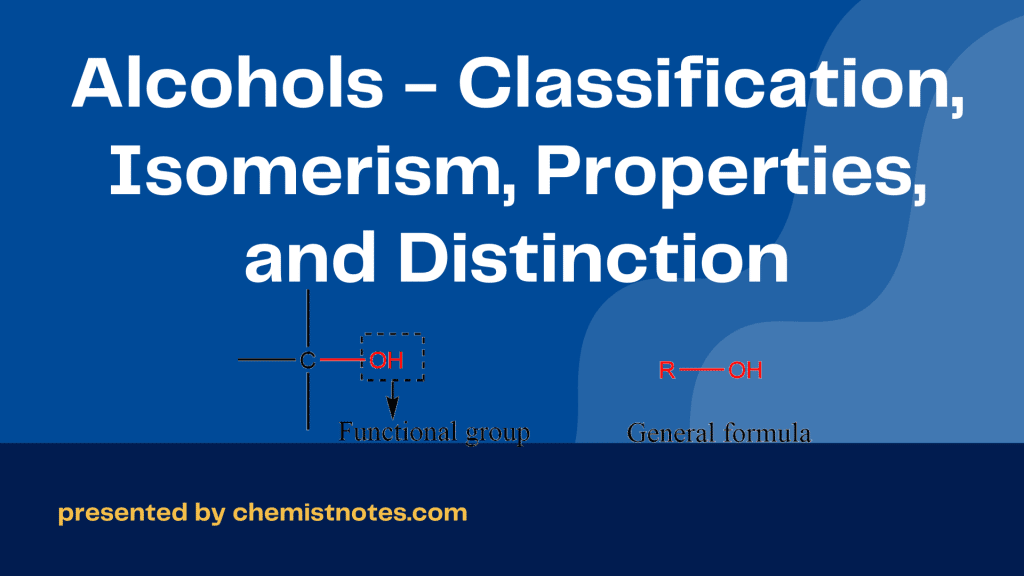
Alcohols are hydroxy derivatives of aliphatic hydrocarbons where the -OH group is bonded to a saturated carbon atom. Alcohols are represented by the general formula R-OH with the hydroxyl group being the functional group. Classification of alcohols Alcohols are classified based on the following two ways: A. On the basis of a number of -OH […]
Transuranium Elements-Definition, Synthesis, and Uses
Transuranium elements are the actinide elements that lie beyond uranium, U92 in the long form of the periodic table. These elements are called urenides. Of these, 26 have been identified and named, or they are awaiting confirmation of their discovery. The eleven-actinide elements from Np93 to Lw103 are called transuranic elements, while those with atomic numbers greater […]
Lanthanides and Actinides Properties – 4 Major Differences
Lanthanides and Actinides are inner-transition elements. Since the last electron i.e. differentiating electron in the atoms of these elements enters the f-subshell belonging to the anti-penultimate shell, these elements are also called f-block elements. Lanthanides are the elements of 6th period of the periodic table ranging from Ce58 to Lu71 in which the last electron […]
Actinides – Series, Characteristics, Electronic Configuration, and Significant Uses
Actinides are those elements in which the last electron enters into the anti-penultimate 5f sub-shell. These are the elements from Ac89 to Lw103 that lie in the 7th period of the periodic table and this series of elements are called actinide series. The name actinide is derived from actinium, the very first member of the series. Most of the […]
Separation of Lanthanides – Ion Exchange Method and Valency Change Method
The separation of lanthanides elements is difficult since their chemical properties are almost identical. The properties of metal ions are mainly determined by their size and charge. The lanthanides are all typically trivalent (charge) and are almost similar in size, and hence possess difficulty in separation. Only two methods are currently used for separating the […]
Lanthanide Contraction – Causes and Consequences
Lanthanide contraction is defined as a gradual decrease in the atomic and ionic radii (M3+ ions) of lanthanide elements as the atomic number increases. Covalent and ionic radii, due to the presence of extra-filled electrons, generally increase on descending a group in the periodic table. However, on increasing Z i.e. moving from left to right […]
Lanthanides – Electronic configuration, Oxidation state, and Uses

Lanthanides are those elements in which the last electron enters into anti-penultimate 4f sub-shell. These are the elements from Ce58 to Lu71 that lie in the 6th period of the periodic table and are called f-block elements since the differentiating electron (last electron) in the atom of these elements enters the f sub-shell belonging to […]
Crystalline solid and Amorphous Solid
Crystalline solid and amorphous solid is the form of solids which are distinguished on the basis of the geometric patterns of their constituents, such as atoms, molecules, or ions. Solids, rigid substances, are characterized by definite shape, incompressibility, and mechanical strength. Unlike gases and liquids, the molecules, atoms, or ions that make up a solid […]