
Bragg’s equation – Braggs law, Derivation, and Application
In 1913, W.L Bragg and his father W.H. Bragg used X-rays to determine the mathematical equation called Bragg’s equation so as to calculate interatomic distances from X-ray diffraction patterns. According to Bragg’s law, “When an x-ray strikes a crystal surface, its angle of incidence, θ, reflects back with the same angle of scattering, θ, and […]
Sandmeyer Reaction mechanism and Applications

Sandmeyer reaction mechanism, examples, and applications in organic chemistry have been discussed here: Sandmeyer reaction In 1884, Traugott Sandmeyer, a Swiss chemist, reported this reaction during the preparation of phenylacetylene from benzenediazonium chloride and cuprous acetylide. When benzene diazonium salt is heated with cuprous chloride or cuprous bromide in presence of corresponding halogen acid from […]
Diagonal relationship in periodic table
Diagonal relationship is a resemblance of the properties of the elements of 2nd period with diagonally opposite members lying in the 3rd period. The two diagonal elements showing similarities in properties are called diagonal pairs. It is the most important feature of the earlier element of the second period (Li, Be, & B) that they […]
Average Velocity, Root Mean Square Velocity, and Most Probable Velocity
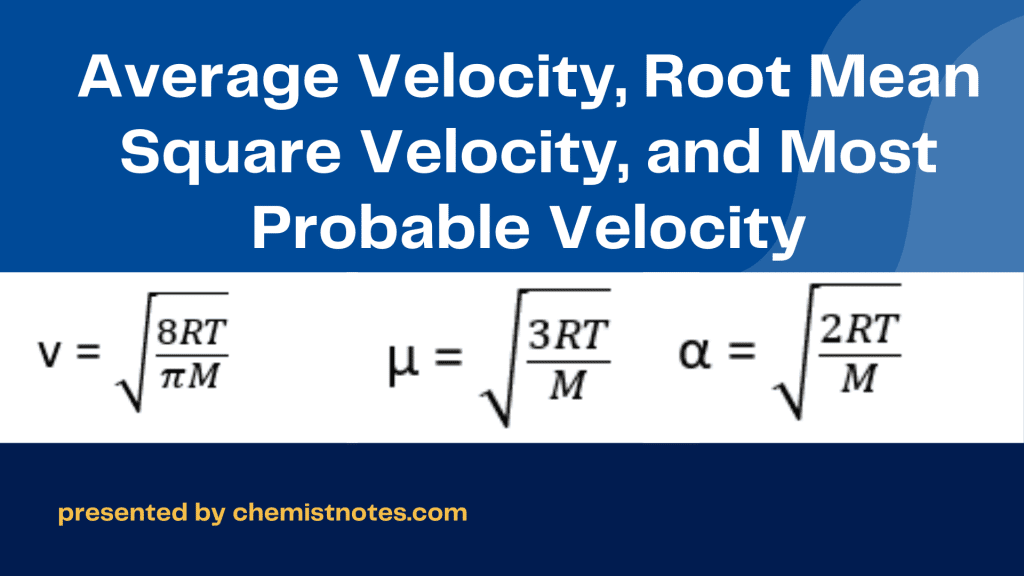
The molecular velocities like average velocity, root mean square velocity, and most probable velocity are well discussed here: Average velocity Average velocity is the arithmetic mean of the various velocities of the molecules. It is symbolically represented by vav or v. If c1, c2, c3, …………cn are the velocities of individual molecules in a gas […]
Maxwell Distribution of Molecular Velocities: Equation, and Features
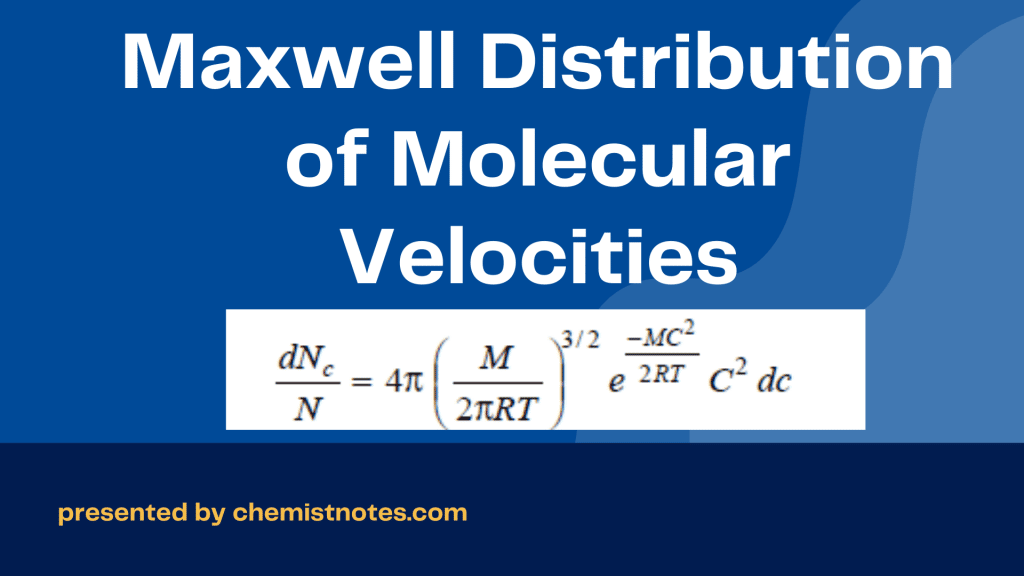
In 1860, James Clark Maxwell calculated the distribution of velocities over different fractions of molecules. This law of distribution is popularly called Maxwell distribution of molecular velocities. where dNc is the number of molecules having velocities between C and (C + dc), N is the total number of molecules, M is the molecular mass, and […]
Van der Waals equation: Units, Derivation, and Limitations
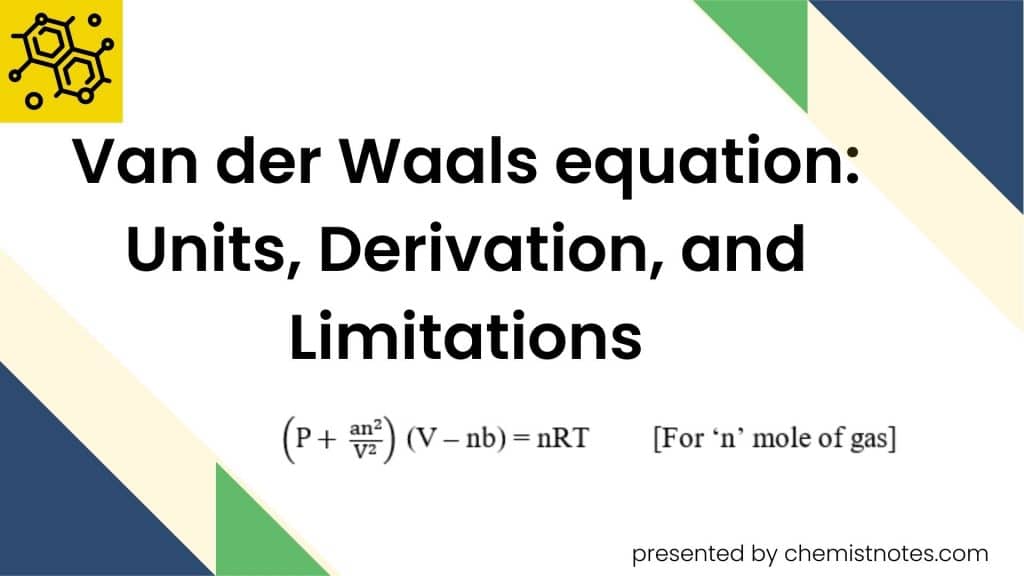
In 1873, J.D. Van der Waals modified the ideal gas equation for real gases by including the effect of Gas molecule interactions (attractive force between the molecules), as well as the molecules’ finite size (final volume of gas molecules). This equation is popularly known as Van der Waals equation. The Van der Waals equation of […]
Surface Tension – Definition, Units, Epic Examples, Effects, and Consequences

Surface tension, one of the important properties shown by liquids, is due to the intermolecular forces of attraction. It depends not only on the attraction of forces between the particles within a liquid but also on the force of attraction of a solid, liquid, or gas that is in contact with it. Thus, it is […]
Graham’s Law of Diffusion, Effusion, and Its Derivation
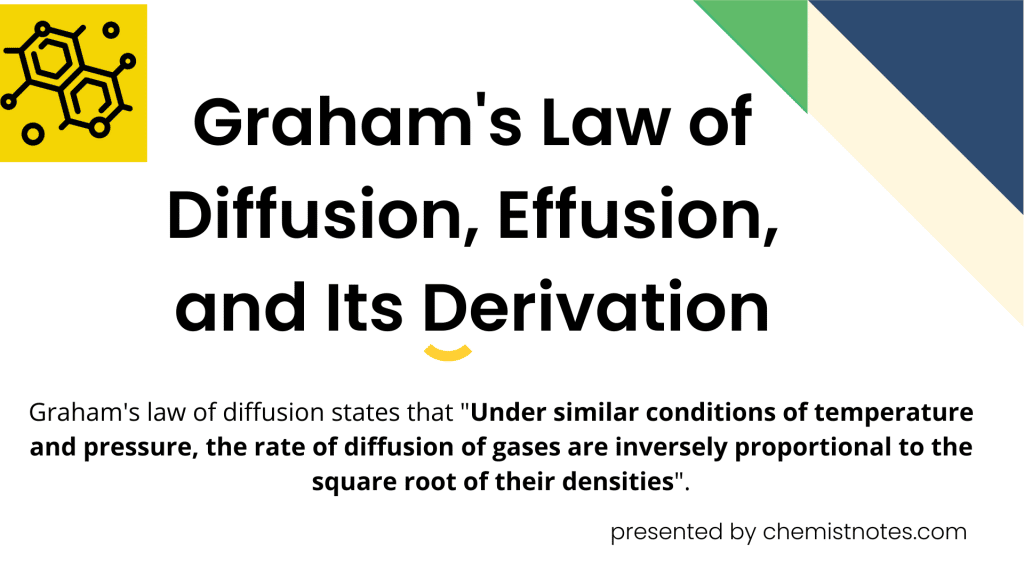
Thomas Graham formulated a law in 1829 to describe the relationship between the rate of diffusion and the densities of gases. This law is known as Graham’s law of diffusion. The process of spontaneous mixing of two or more gases by the random motion of the molecules is called diffusion. Graham’s law of diffusion states […]
Ideal Gas Law (PV = nRT): Derivation and Numerical Values of R
The ideal gas law, also known as the ideal gas equation, applies to all gases that show ideal behavior, or that perfectly obey the gas laws. Gases are considered ideal only if (i) the volume of the molecules is negligibly small in comparison to the volume of the gas, (ii) a large number of molecules […]
Gas Laws – Boyle’s Law, Charle’s Law, Gay-Lussac’s Law, Avogadro’s Law, and Combined Ga Law
Gas laws describe the general behavior of gases. When conditions are normal, all gases exhibit similar behavior. However, even minor changes in physical conditions such as pressure, temperature, or volume cause a deviation. Thus, gas laws define relationships among the temperature, pressure, and volume of a gas. The gas laws are: Boyle’s law Charle’s law […]
Faraday’s law of electrolysis: First and Second law
Michael Faraday (1834) proposed a quantitative relationship between the quantity of electricity passed through electrolytes and the amount of the substance liberated at an electrode. This law of electrolysis is called Faraday’s law of electrolysis. The phenomenon of decomposition of an electrolyte in the molten or aqueous state by passing an electric current through them […]
Phosphorescence: Definition, principle, and applications

When certain substances are exposed to light, they emit light for a period of time after the light source is cut off. This phenomenon is known as phosphorescence and such substances are called phosphorescent substances. Generally, solid substances such as zinc sulphide, and sulphide of alkaline earth metals exhibit this phenomenon as the molecules have […]