
Stability of Alkenes and Heat of Hydrogenation
The stability of alkenes depends on various factors. The heat of hydrogenation can frequently provide useful information about the relative stabilities of unsaturated compounds. For example, of the isomeric 2-butenes, the cis isomer has a heat of hydrogenation of 28.6 kcal, and the trans isomer has 27.6 kcal. Both reactions consume one mole of hydrogen […]
Chemical Properties of Alkenes: Some Reactions involved in Alkenes
Chemical properties of alkenes mainly due to the presence of double bond. Alkenes are more reactive than alkanes because the π electrons of a double bond are located much farther from the carbon nuclei and are thus less firmly bound to them. The overlap of the atomic orbitals in forming a π-bond is not as effective as […]
Organic and Inorganic Compounds: Difference between Organic and Inorganic Compounds
Organic and inorganic compounds differ in many respects, including composition, origin, structure, and properties. Chemistry is a fundamental branch of science that deals with the composition, preparation, and properties of various substances. These substances are made of one or different compounds. There are two main classes of chemical compounds; Definition More than a century ago […]
Organic Compounds and Organic Chemistry
Organic compounds are binary compounds of carbon and hydrogen, i.e., hydrocarbons, and their derivatives, which directly or indirectly involve living matters. Carbon is an essential element of organic compounds and remains covalently bonded with other elements like hydrogen; many organic compounds contain oxygen; some contain nitrogen; and a few contain sulfur, phosphorous, halogens, and even […]
Hydrocarbons: Detail explanation of formula, types, and isolation of hydrocarbon
What is a hydrocarbon? Hydrocarbons are organic compounds that only contain hydrogen and carbon. On the basis of structure, hydrocarbons are divided into two main classes: aliphatic and aromatic. Aliphatic hydrocarbons are further divided into alkanes, alkenes, and alkynes and their cyclic analogs (cycloalkanes, etc.) Saturated hydrocarbon The hydrocarbons that contain a carbon-carbon single bond […]
Cannabis: Chemical composition and uses
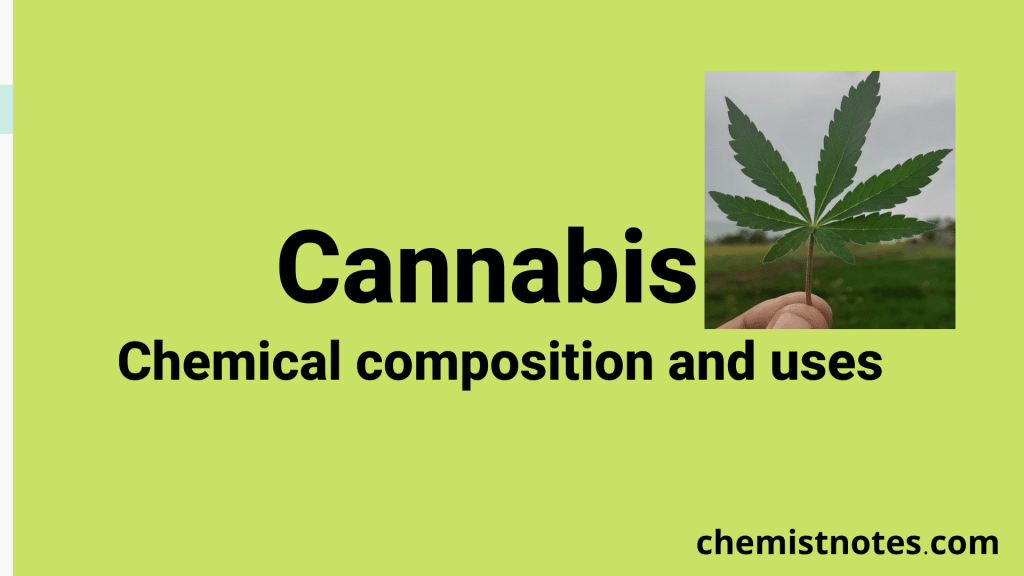
What is cannabis? Cannabis, which belongs to the Cannabaceae family, contains three main species of cannabis: Cannabissativa, Cannabis indica, and Cannabis ruderalis. In the common tongue, it is called Hemp andMarijuana. The word Hemp is for non-psychoactive cannabis and marijuana is for psychoactivecannabis. Cannabis sativa is a species of plant with a rich, yet controversial history. […]
Alkynes: Formula, structure, nomenclature, uses, and properties
Alkynes are unsaturated hydrocarbons that contain a carbon-carbon triple bond -C≡C-. These are more unsaturated than alkenes. The first member of this series of hydrocarbons is acetylene (CH≡CH) and these are called acetylenes. The triple bond is often referred to as the acetylenic linkage. Acetylenic linkage is regarded as the functional group of alkynes. Formula […]
Alkenes: formula, structure, nomenclature, properties, and uses
What is an alkene? Alkenes are hydrocarbons that contain a carbon-carbon double bond (=C=C=) in their molecule. Alkenes are commonly known as olefins (in Latin, olefins mean “oil-forming) because the lower member of the series reacts with chlorine to form oily products. Ethylene (C2H4) is the first member of the series. The carbon-carbon double bond […]
Alkanes: Detail explanation of the structure, nomenclature, and properties

Alkanes are saturated hydrocarbons in which each carbon atom is bonded to another carbon atom and hydrogen atom by a single covalent bond (sigma bond). They are also called paraffin (the Latin word paraffin means little affinity or reactivity). Hence, alkenes are relatively unreactive towards most of the reagents like acids, bases, oxidizing agents, and […]
Stereoselective reactions and stereospecific reactions: Definition and some examples
Stereoselective reactions are reactions that produce predominantly one stereoisomer (or one pair of enantiomers) out of several possible diastereomers. Which product we obtain depends on which stereoisomers we start with. However, a stereospecific reaction is one in which stereochemically different molecules react differently. “Stereochemically different” molecules are meant to be stereoisomers, i.e., enantiomers or diastereomers, […]
Electrophoresis/ Cataphoresis: Definition, principle, and application
Electrophoresis, or cataphoresis, is the migration and separation of charged particles (ions) under the influence of an electric field. Ferdinand Frederic Reuss was the first person to detect electrophoresis in 1807. If the sol particles migrate toward the positive electrode, they carry a negative charge; on the other hand, if they migrate toward the negative electrode, they […]
Chemical oxygen demand(COD): Definition, and calculation
Chemical oxygen demand is an index of pollution that measures the effect of pollutants on dissolved oxygen. In the COD test, an oxidant other than O2 is used to degrade the pollutants in the water sample. The amount of the oxidant consumed is experimentally measured to calculate the equivalent amount of oxygen required by the […]